
Early Design Decisions That Protect Building Performance
As projects start to take shape for the year ahead, one pattern keeps coming up in conversations across the industry.
Most performance outcomes are decided far earlier than people expect.
Over January, we shared a short series of observations around early-stage design decisions — not to promote a system, but to highlight where projects quietly succeed or struggle long before site activity begins.
Taken together, they point to one simple truth:
early clarity doesn’t lock a design down — it protects it.
Why the building envelope should be decided before the floor plan
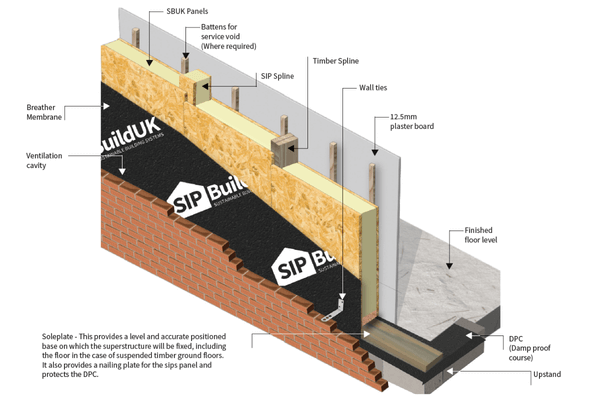
The building envelope isn’t something to simply “slot in” later. It’s one of the earliest decisions that shapes form, junctions, detailing and overall buildability.
Many projects already have a floor plan by the time the build system is being considered — that’s common. What matters is whether the envelope strategy is properly resolved before the design is fixed, when performance targets become clearer and coordination far simpler.
Further reading:
What SIPs are / how SIPs form the building envelope
Thermal performance / fabric-first / SIP advantages
Early SIP coordination: the design risks it quietly removes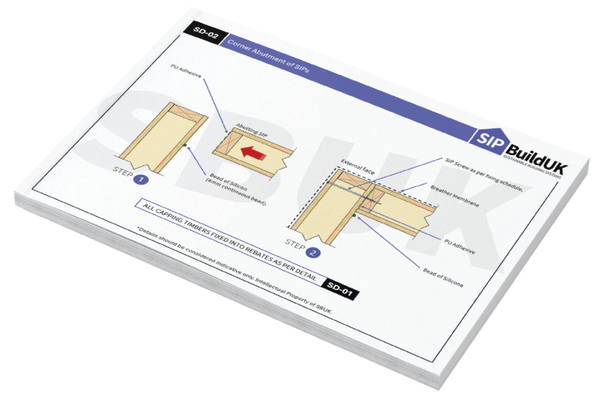
Early coordination rarely shows up as a headline benefit.
What it tends to remove instead are quieter risks — repeated redraws, unclear responsibility at interfaces, and junctions only being resolved under pressure.
When structure and envelope decisions are coordinated early, responsibility lines are clearer and downstream detailing becomes far more predictable.
Further reading:
Airtightness isn’t a target — it’s a design outcome
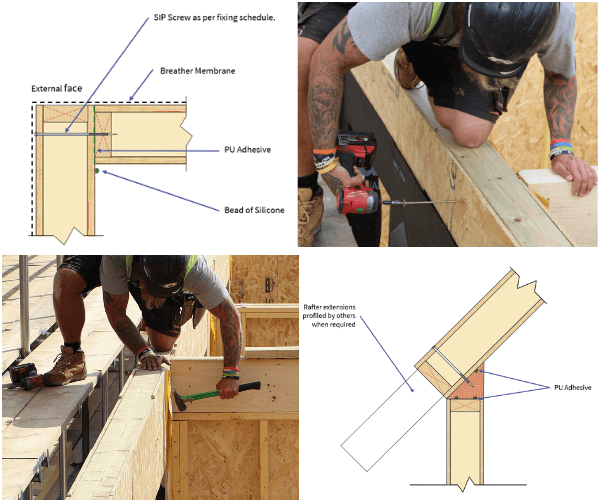
Airtightness is often treated as something to be achieved at the end of a project.
In reality, it’s largely decided much earlier, at the detailing stage.
Good airtightness doesn’t come from chasing a number. It comes from clear design decisions, consistent detailing, and systems that are allowed to do the job they were designed for.
Further reading:
Case study: Stotfold Crest Stables – SIP Self Build Development
Airtightness and energy efficiency with SIPs
Reviewing a project at concept stage?
Send over your plans and we’ll help sense-check envelope and junction decisions before they become fixed.
Request an early-stage review
Where SIP projects really succeed: junctions and U-values working together
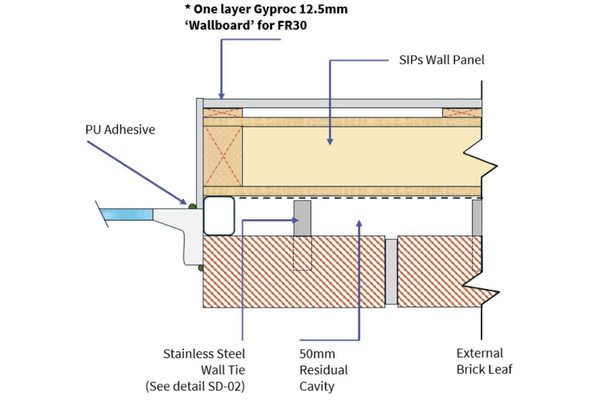
U-values are important — they set the baseline.
But it’s at the junctions where those figures are either protected or quietly undermined.
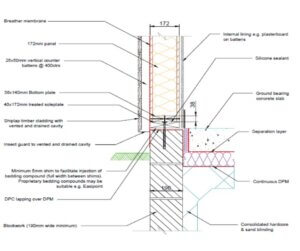
Real-world performance depends on how well thermal targets are carried through junctions, interfaces and transitions, and how consistently those details are delivered.
When junctions are properly resolved at design stage, U-values don’t become theoretical. They become repeatable, reliable outcomes — without relying on site fixes or best-case assumptions.
Further reading:
Case study: Stotfold Crest Stables – SIP Self Build Development
SIPs specifications – U values and system performance
Reviewing a project at concept stage?
Send over your plans and we’ll help sense-check envelope and junction decisions before they become fixed.
Request an early-stage review
Taken together, these points all lead to the same conclusion:
early clarity doesn’t lock a design down — it protects it.
As programmes tighten and expectations rise, predictability is becoming the real performance metric. Not just how a building performs on paper, but how reliably it can be delivered in practice.
If you’re reviewing a project at an early stage and want to sense-check envelope or junction decisions before they become fixed, we’re always happy to have that conversation early — when it’s most useful.
Design Process
1. Receipt of Building Regulations drawings package.
Upon receipt of your frozen design package, we will review the content to ensure that this matches our scope of supply and estimate documents, at which point we will get our design team to commence design on the project.
Drawings required from yourself typically are building regulations standard or construction issue in both PDF and DWG formats;
- Plans showing full build ups and SIPs/Timber frame positioning.
- Sections showing full build ups and SIPs/Timber frame positioning.
- Build up details and specifications.
- Any information available in terms of utilised systems such as MVHR, underfloor heating, Solar etc – their locations, weights, and specifications.
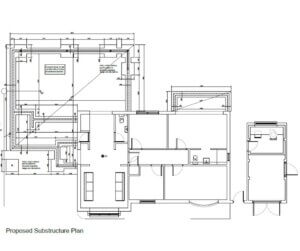
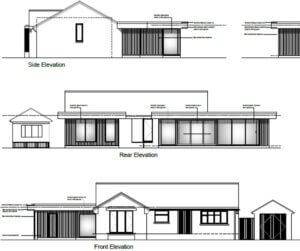
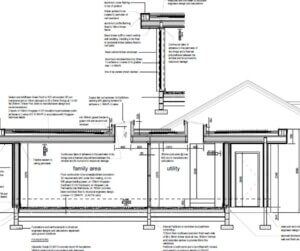
The above helps us set the parameters accurately for design setting out, whilst also being able to value engineer your project by accurately allowing for the loadings required and not going above and beyond in engineering. Often ensuring we have information about underfloor heating for example allows us to engineer and avoid rework later down the line.
Something we do get asked on occasions is ‘future allowance’. Even if you do not intend to install the likes of a lift for instance through the floor zone, or solar panels at the point of yourself building the project, it may be a good consideration to include the loading for such, in the event that future residents may consider this.
 2. line and point load engineering issue.
The first issue of design co-ordination from ourselves at SBUK would be the engineered line and point loads. The issue of these will form a large part of your structural design below ground and within your structural slab ahead of our commencement on site. It is imperative that these are issued to your structural engineer and that all loads are catered for within your foundation and substructure arrangement.
Useful link;
www.structuralbasics.com/point-load/
Please note that we are not responsible for your foundation and slab engineering and detailing.
3. Preliminary design issue.
Once we have the line and point loads we are able to apply these to our initial designs and in turn issue to yourself for review, comment and approval where relevant. This initial issue will be titled P1 (preliminary 1).
In terms of your review, we will request that you in turn look through each individual document issue, mark up any specifics for comment, amendment or in the case of approval, stamp the drawings by means of status A,B or C.
Useful link;
https://constructandcommission.com/what-is-document-status-a-b-c-d/
What should be included in a complete set of Architectural Plans?
Let’s dive into the details!
The time it takes for architectural plans to reach the design stage can vary depending on a variety of factors. However, on average, the duration can range from a few weeks to several months. The timeline primarily depends on the complexity and scale of the project, the level of detail required, and the collaboration between the architect and the client.
To quickly access our detailed explanation about what should be included in a complete set of architectural plans, click here.
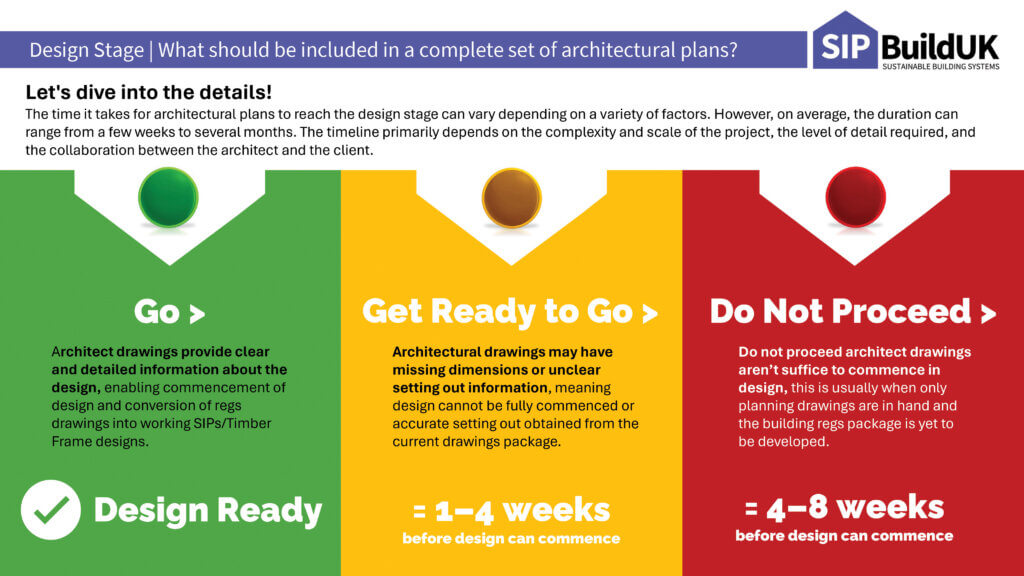
We’ve provided clear insights into the typical components found in comprehensive architectural plans, ensuring you have the information you need. If you have any further questions, don’t hesitate to ask. We’re here to help! Contact us by email or phone.
What foundation should be used?
The issue of engineered line and point loads will form a large part of your structural design below ground and within your structural slab ahead of our commencement on site.
It is imperative that these are issued to your structural engineer and that all loads are catered for within your foundation and substructure arrangement.
Please note that we are not responsible for your foundation and slab engineering and detailing.
What are line and point loads and why do they matter?
Engineered line and point loads form a key part of your structural design and must be issued to your structural engineer before groundwork begins. These loads are applied to preliminary SIP designs for review and approval.
The first issue of design coordination from SIP Build UK is the engineered line and point loads.
The issue of these will form a large part of your structural design below ground and within your structural slab ahead of our commencement on site. It is imperative that these are issued to your structural engineer and that all loads are catered for within your foundation and substructure arrangement.
Once we have the line and point loads, we are able to apply these to our initial designs and issue preliminary drawings for review, comment and approval. This initial issue is titled P1 (preliminary 1).
We will request that each individual document is reviewed, with drawings marked up for comment, amendment or approval using status A, B or C.
Please note that we are not responsible for your foundation and slab engineering and detailing.
Why should the building envelope be decided before the floor plan?
Most performance outcomes are decided far earlier than people expect. Early clarity doesn’t lock a design down — it protects it.
Most performance outcomes are decided far earlier than people expect.
Over January, we shared a short series of observations around early-stage design decisions — not to promote a system, but to highlight where projects quietly succeed or struggle long before site activity begins.
Taken together, they point to one simple truth:
early clarity doesn’t lock a design down — it protects it.
The building envelope isn’t something to simply “slot in” later. It’s one of the earliest decisions that shapes form, junctions, detailing and overall buildability.
Many projects already have a floor plan by the time the build system is being considered — that’s common. What matters is whether the envelope strategy is properly resolved before the design is fixed, when performance targets become clearer and coordination far simpler.
Early coordination rarely shows up as a headline benefit. What it tends to remove instead are quieter risks — repeated redraws, unclear responsibility at interfaces, and junctions only being resolved under pressure.
When structure and envelope decisions are coordinated early, responsibility lines are clearer and downstream detailing becomes far more predictable.
Airtightness is often treated as something to be achieved at the end of a project. In reality, it’s largely decided much earlier, at the detailing stage.
Good airtightness doesn’t come from chasing a number. It comes from clear design decisions, consistent detailing, and systems that are allowed to do the job they were designed for.
U-values are important — they set the baseline. But it’s at the junctions where those figures are either protected or quietly undermined.
Real-world performance depends on how well thermal targets are carried through junctions, interfaces and transitions, and how consistently those details are delivered.
When junctions are properly resolved at design stage, U-values don’t become theoretical. They become repeatable, reliable outcomes — without relying on site fixes or best-case assumptions.
Taken together, these points all lead to the same conclusion:
early clarity doesn’t lock a design down — it protects it.
As programmes tighten and expectations rise, predictability is becoming the real performance metric. Not just how a building performs on paper, but how reliably it can be delivered in practice.
If you’re reviewing a project at an early stage and want to sense-check envelope or junction decisions before they become fixed, we’re always happy to have that conversation early — when it’s most useful.
Further reading links
SIP specifications – U-values and system performance
https://sipbuilduk.co.uk/sips-explained/sips-specifications-3-2/
Case study: Stotfold Crest Stables – SIP Self Build Development
https://sipbuilduk.co.uk/case-studies/stotfold-crest-stables-sip-self-build-development/
Request an early-stage review / Contact
https://sipbuilduk.co.uk/contact-us/
Do you provide Stage 4 architectural drawings for SIP projects?
SIP Build UK provides design and structural engineering drawings for the SIP system. Architectural Stage 4 drawings remain the responsibility of the project architect.
SIP Build UK provides the design and structural engineering drawings required for the SIP system as part of our project package.
These drawings include the engineering design of the SIP structure along with the supporting structural calculations required for the system.
However, we do not produce the architectural Stage 4 drawings for the building. These are completed by the project architect as part of the overall architectural design and Building Regulations package.
Our design work focuses specifically on the SIP structure, ensuring that the system is engineered correctly and coordinated with the architectural drawings provided by the project architect.
If you would like us to review your project drawings for a SIP estimate, you can send them to our team via the contact page: https://sipbuilduk.co.uk/contact-us/
Can SIP Build UK design the mechanical and electrical M&E system layout for my project?
SIP Build UK does not design mechanical and electrical (M&E) systems for projects. This is typically completed by the architect or an appointed M&E consultant as part of the wider design team.
SIP Build UK does not design the distribution of mechanical and electrical (M&E) systems within a building.
This work is typically carried out by the project architect or an appointed M&E consultant as part of the wider design package. They will be responsible for designing and coordinating the building services layout, including heating, ventilation, plumbing and electrical systems.
Once this information is developed, it is considered during the SIP design stages to ensure the building structure and envelope can accommodate the required services.
Do you provide quantity surveying or structural engineering consultancy for SIP builds?
SIP Build UK is responsible for the structural engineering of the SIP frame only. Quantity surveying and wider project consultancy services are typically arranged independently by the client or design team.
SIP Build UK is responsible for the structural engineering design of the SIP frame only.
This includes the engineering calculations and design information required for the SIP structure as part of our project package.
Quantity surveying services and wider project consultancy are not provided by SIP Build UK. These roles are typically appointed independently by the client as part of the wider design and cost management team.
Many projects choose to appoint a quantity surveyor during Stages 2, 3 and 4 to help manage costs and maintain budget control throughout the design and construction process.
If you would like us to review your project drawings for a SIP estimate, you can send them to our team via the contact page:
https://sipbuilduk.co.uk/contact-us/
required services.