
What wall build-ups and U-values can SIP external walls achieve?
Panel thicknesses typically range from 100 mm to 225 mm, with U-values as low as 0.11 W/m²K achievable using a 225 mm panel, depending on the overall wall build-up.
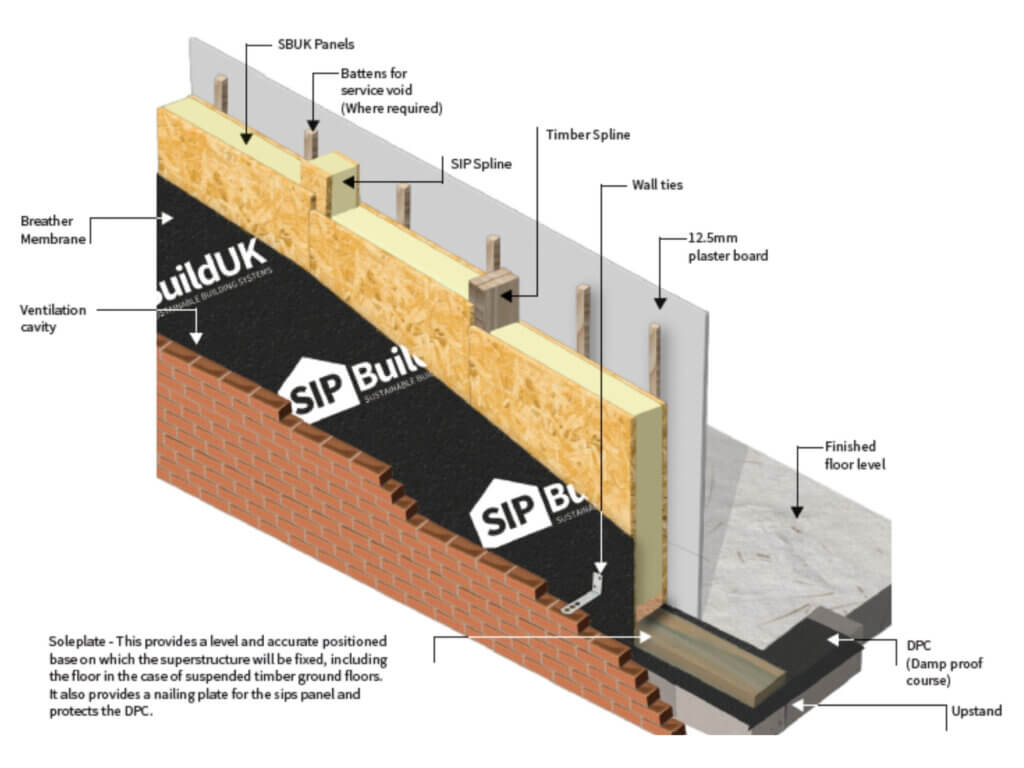
The final thermal performance will depend on the full construction, including external finishes, internal linings, membranes and vapour control layers. For this reason, we always recommend carrying out project-specific calculations to confirm the exact performance for your design.
For full panel thickness options and performance tables, see our SIP Specifications page.
Can services be installed in SIP walls?
No. SIP panels are a thermally efficient, airtight product and perform best without services running through them.
We would always recommend the use of a counter batten to create a service void behind the panel so that services such as electrics and plumbing can be positioned without penetrating the SIP envelope itself.
For deeper detail on SIP technical performance or panel build-ups:
👉 https://sipbuilduk.co.uk/sips-explained/sips-specifications-3-2/
Options for external finishes
SIP buildings can be finished with brick, render, timber cladding or rainscreen systems.
SIP buildings can be finished with a wide range of external finishes including brick, render, timber cladding and rainscreen systems. SIP Build UK designs the SIP superstructure to suit your chosen external finish, allowing flexibility in appearance while maintaining performance.
👉 https://sipbuilduk.co.uk/external-finishes-and-rainscreen-claddings/
Are SIPs suitable for low energy builds?
Yes. A live SIP self-build achieved a U-value of 0.15 W/m²K with no additional insulation and now records zero heating bills with stable year-round comfort.
The Stotfold Crest Stables self-build project demonstrates the real-world performance of a SIP superstructure in a low-energy home.
 Front elevation of the Stotfold Crest SIP home, combining soft-stone cladding and full-height glazing for a modern rural aesthetic.[/caption]
Set within coastal exposure to the North Sea, the brief required exceptional thermal performance and year-round comfort.
The home’s 172 mm SIP panels achieve a U-value of 0.15 W/m²K with no additional insulation.
Now fully occupied, the property provides a full year of post-occupancy data:
- Zero heating bills: The combination of SIP fabric, Ground Source Heat Pump (GSHP) and Solar PV results in a home that exports around £900 per quarter in energy credit.
- Year-round comfort: Internal temperature variation of less than 1.5°C between seasons, achieved with no mechanical cooling.
- Acoustics: Internal sound levels averaging under 30 dB despite proximity to a working yard and the A19.
- Maintenance: After a year of coastal exposure — zero fabric issues.
The project demonstrates a fabric-first approach, with a SIP envelope already exceeding the 2025 Future Homes Standard.
Real-world performance data shows low running costs, airtight comfort and stable internal conditions throughout harsh North East winters.
Full case study:
https://sipbuilduk.co.uk/case-studies/stotfold-crest-stables-sip-self-build-development/
Do I need Mechanical Ventilation with Heat Recovery?
Ventilation requirements are governed by Building Regulations and your project’s airtightness performance. The choice between MVHR and natural ventilation will depend on the air pressure test result and the preferred ventilation strategy for the building.
Whether a building requires Mechanical Ventilation with Heat Recovery (MVHR) or can rely on natural ventilation is determined by Building Regulations and the overall airtightness performance of the building.
SIP buildings are designed to achieve high levels of airtightness, which improves energy performance but also means that a clear ventilation strategy must be in place.
The appropriate approach will depend on the air pressure test result for the building as well as the preferred ventilation strategy for the project. In many low-energy buildings, MVHR systems are commonly used to provide controlled ventilation while recovering heat from the outgoing air.
Your architect and building services designer will determine the most suitable ventilation strategy for your project in order to comply with Building Regulations.