
What is Welfare and why is it needed
- Health and Safety: Ensuring the health and safety of construction workers is a top priority in the UK construction industry. Site welfare facilities help minimize risks by providing a safe and hygienic environment for workers to rest, eat, and access essential services.
- Rest and Breaks: Construction work can be physically demanding and mentally taxing. Site welfare facilities offer workers a place to take breaks, rest, and recharge. Adequate rest is crucial for maintaining concentration and reducing the risk of accidents due to fatigue.
- Hydration and Nutrition: Access to clean drinking water and food storage facilities is vital to keep workers properly hydrated and nourished throughout the workday. Adequate nutrition and hydration contribute to workers’ overall health and well-being.
- Toilet Facilities: Construction sites are often located in areas where public restroom facilities are not readily available. Site welfare includes provision for clean and accessible toilet facilities, which are essential for workers’ comfort and hygiene.
- Handwashing and Personal Hygiene: Proper handwashing facilities with soap and water are crucial for maintaining personal hygiene, reducing the spread of germs, and preventing the risk of infections and illnesses on site.
- First Aid and Medical Care: Site welfare may include first aid stations or medical rooms equipped to handle minor injuries and medical emergencies. Prompt access to medical care can make a significant difference in the event of an accident.
- Warm and Dry Shelter: In the UK’s variable weather conditions, it’s essential to provide shelter from rain, wind, and cold temperatures. Site welfare facilities often include sheltered areas where workers can seek refuge during adverse weather.
- Privacy and Dignity: Adequate site welfare facilities respect workers’ privacy and dignity. Access to clean and private toilet and washing facilities is a fundamental aspect of this.
- Legal Requirements: UK health and safety regulations, including the Construction (Design and Management) Regulations 2015, require construction sites to provide suitable and sufficient welfare facilities for workers. Failure to comply with these regulations can result in legal consequences and penalties.
- Productivity and Morale: Site welfare facilities contribute to higher worker morale and job satisfaction, which will ultimately lead to higher productivity.
Customer Journey
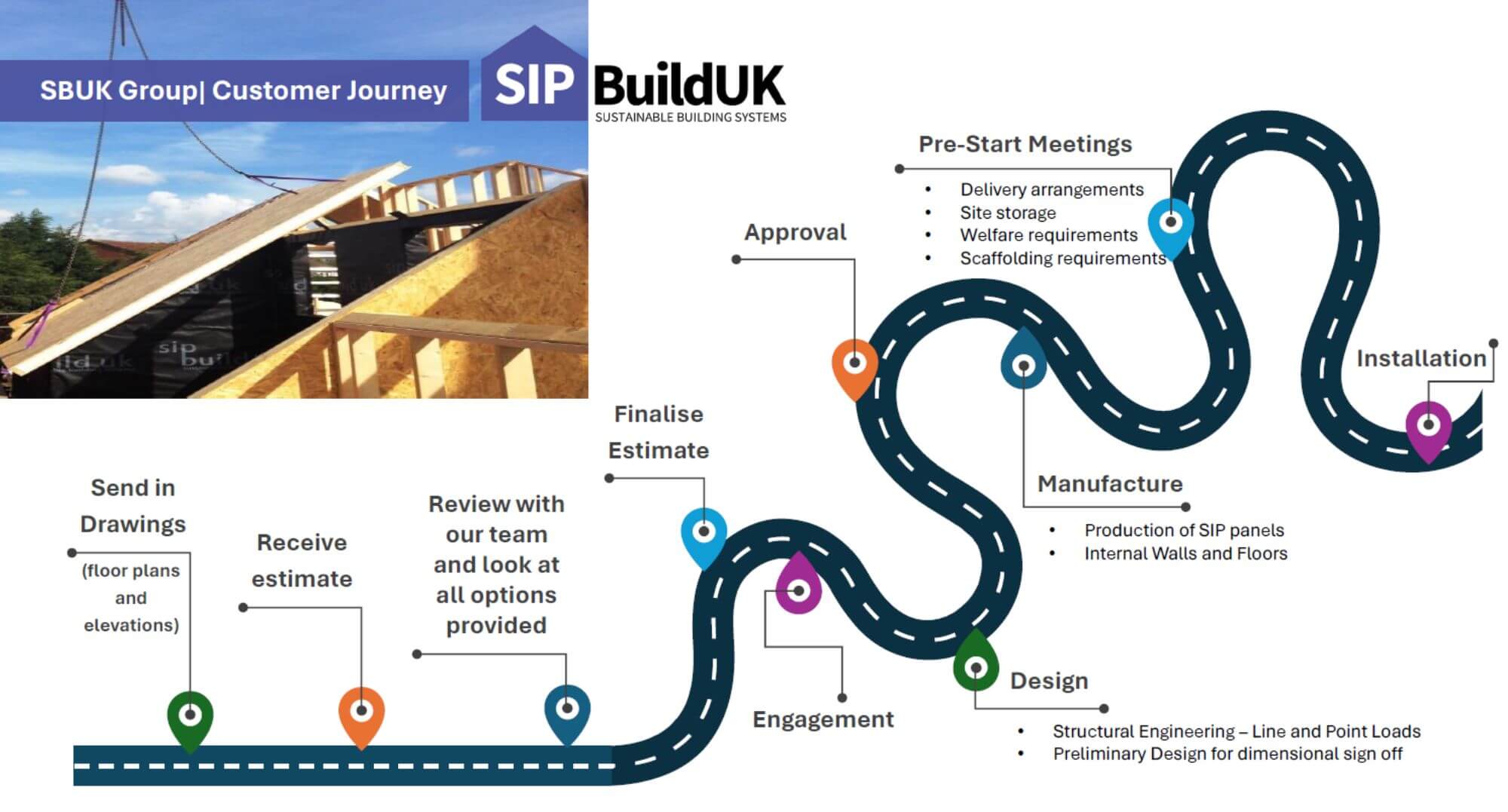
Transparency and clarity are key throughout your self build journey, and we’re here to provide just that. Here’s a simple breakdown of the steps involved, from your initial enquiry to the installation of your SIPs super structure:
Download a PDF version here
How does the SIP build process work?
From drawings and estimate through to manufacture and installation, our process is structured, transparent and clearly defined. Each stage is coordinated to ensure design clarity, buildability and programme certainty.
Transparency and clarity are key throughout your self build journey, and we’re here to provide just that.
Here’s a simple breakdown of the steps involved, from your initial enquiry to the installation of your SIPs super structure:
- Send in drawings
(Floor plans and elevations) - Receive estimate
- Review with our team
Look at all options provided. - Finalise estimate
- Approval
- Pre-start meetings
- Delivery arrangements
- Site storage
- Welfare requirements
- Scaffolding requirements
- Manufacture
- Production of SIP panels
- Internal walls and floors
- Design
- Structural engineering – line and point loads
- Preliminary design for dimensional sign off
- Installation
Do you supply only or provide a full service?
We design, engineer, manufacture, supply and install SIP superstructures for self build, residential, educational and commercial projects. Our service covers everything from design through to on-site installation.
We design, engineer, manufacture, supply and install SIP superstructures for self builders, residential developers, educational and commercial projects.
👉 Contact us:
https://sipbuilduk.co.uk/contact-us/
What needs to be agreed before SIP manufacture starts?
A frozen design package, full construction drawings and system information must be agreed before manufacture begins. Engineered line and point loads and preliminary drawings are issued for review and approval prior to production.
Upon receipt of your frozen design package, we review the content to ensure it matches our scope of supply and estimate documents, at which point our design team commences work on the project.
Drawings required are typically Building Regulations standard or construction issue in both PDF and DWG formats, including:
- Plans showing full build-ups and SIP positioning
- Sections showing full build-ups and SIP positioning
- Build-up details and specifications
- Information on utilised systems such as MVHR, underfloor heating and Solar, including locations, weights and specifications
This information allows us to accurately set design parameters and value engineer the project by allowing for the loadings required.
The first issue of design coordination is the engineered line and point loads, which must be issued to your structural engineer and catered for within the foundation and substructure arrangement.
Once line and point loads are completed, we apply these to our initial designs and issue preliminary drawings (P1) for review, comment and approval.
Each document is reviewed individually and marked for comment, amendment or approval using status A, B or C.
What causes redesign and delays on SIP projects?
Redesign and delays often come from late envelope decisions, unresolved junctions and unclear responsibility at interfaces. Early clarity doesn’t lock a design down — it protects it.
Early coordination rarely shows up as a headline benefit.
What it tends to remove instead are quieter risks — repeated redraws, unclear responsibility at interfaces, and junctions only being resolved under pressure.
Many projects already have a floor plan by the time the build system is being considered — that’s common. What matters is whether the envelope strategy is properly resolved before the design is fixed, when performance targets become clearer and coordination far simpler.
The building envelope isn’t something to simply “slot in” later. It’s one of the earliest decisions that shapes form, junctions, detailing and overall buildability.
When structure and envelope decisions are coordinated early, responsibility lines are clearer and downstream detailing becomes far more predictable.
Airtightness is often treated as something to be achieved at the end of a project. In reality, it’s largely decided much earlier, at the detailing stage.
U-values are important — they set the baseline. But it’s at the junctions where those figures are either protected or quietly undermined.
Real-world performance depends on how well thermal targets are carried through junctions, interfaces and transitions, and how consistently those details are delivered.
Taken together, these points all lead to the same conclusion:
early clarity doesn’t lock a design down — it protects it.
As programmes tighten and expectations rise, predictability is becoming the real performance metric. Not just how a building performs on paper, but how reliably it can be delivered in practice.
If you’re reviewing a project at an early stage and want to sense-check envelope or junction decisions before they become fixed, we’re always happy to have that conversation early — when it’s most useful.
Site Signage
In the UK, building site signage is essential for safety and compliance with legal requirements. The Health and Safety (Safety Signs and Signals) Regulations 1996 and the Construction (Design and Management) Regulations 2015 (CDM 2015) outline the requirements for signage on construction sites.
- Health and Safety Law Poster: Employers must display the approved poster in a prominent place or distribute equivalent leaflets to employees.

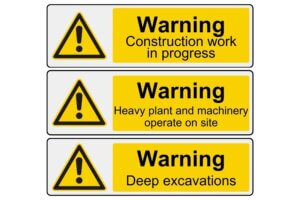
- Warning Signs:These signs warn of hazards or dangers, such as deep excavations, overhead loads, or the presence of asbestos. They are usually yellow with black text and symbols.
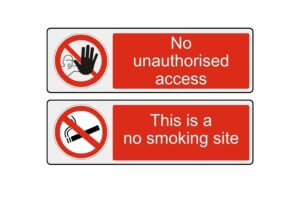
- Prohibition Signs: These signs prohibit specific actions to maintain safety, such as “No Smoking” or “No Entry” signs. They are generally red with white text and symbols.
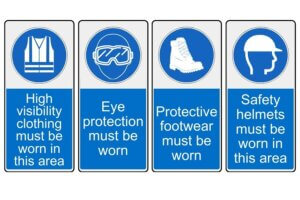
- Mandatory Signs: Indicating actions that must be taken, such as wearing hard hats, safety goggles, or other personal protective equipment (PPE). These signs are usually blue with white text and symbols.
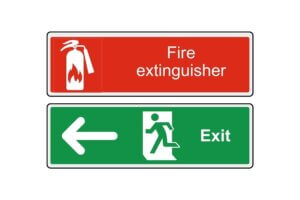
- Fire Safety Signs: Identifying firefighting equipment and emergency exits. These are often red (for fire equipment signs) or green (for exit signs).
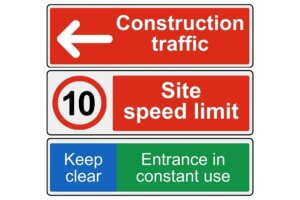
- Traffic and Pedestrian Management Signs: Directing vehicle and pedestrian movements around and within the site to ensure safety. These can include speed limits, pedestrian routes, and vehicle parking areas.
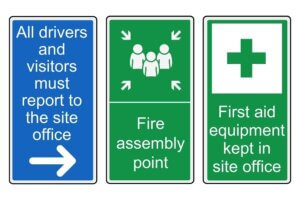
- Information Signs: Providing general information, such as site office locations, first aid posts, and assembly points. These signs are often white or green with text and symbols.
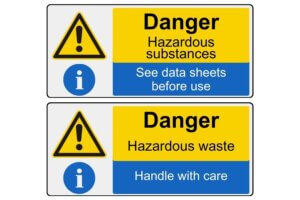
- Hazardous Substance Signs: Warning about dangerous substances. These must comply with the Classification, Labelling and Packaging (CLP) Regulation.
- Site Safety Boards: Often placed at site entrances, these boards provide a range of information including emergency contact numbers, the names of key health and safety personnel, and specific hazards on the site.
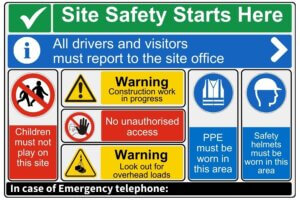
Signage required can vary depending on the nature and location of the project. It’s important to conduct risk assessments to determine the necessary signs for the site to ensure compliance and maintain safety. Additionally, it’s essential to ensure that all signs are clear, legible, and well-maintained throughout the project. The items mentioned here are only a brief understanding of what may be required – to ensure compliance the advice of a suitably qualified professional should always be sought.